

Product Usage: For Research Use Only – Not for Human or Veterinary Use
This product is not a drug, food, cosmetic, or dietary supplement and has not been evaluated by the FDA. It is strictly intended for in vitro research by qualified professionals. Any use in humans or animals is strictly prohibited and may violate federal, state, or local laws, including the Federal Food, Drug, and Cosmetic Act. No therapeutic or diagnostic application is implied or permitted. The purchaser assumes all responsibility for compliance with applicable regulations.
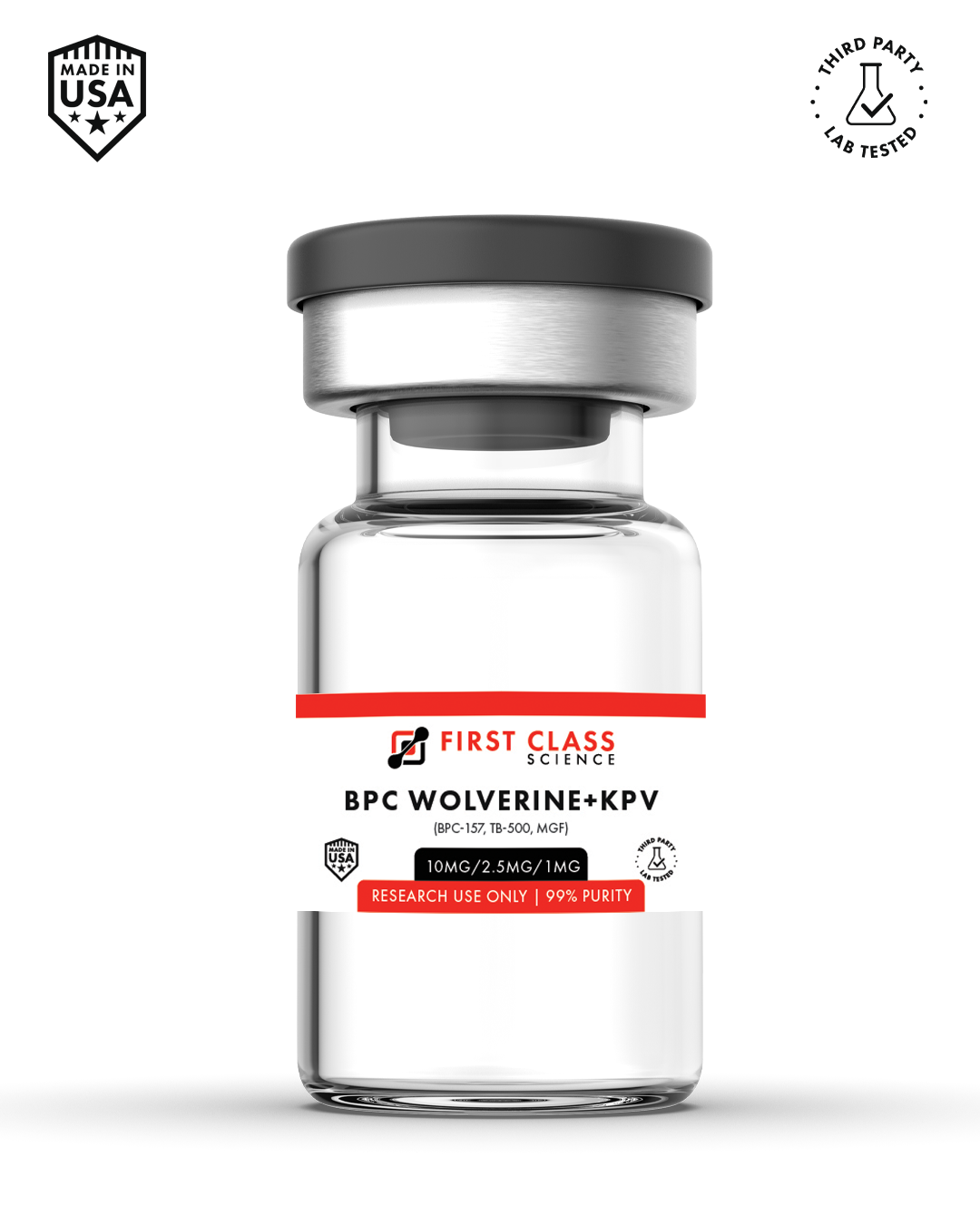
BPC Wolverine + MGF & KPV – 14.5mg
14.5mg lyophilized blend of BPC-157, TB-500, MGF, and KPV — four peptides studied independently across tissue-repair, cell-signaling, and anti-inflammatory research models. Supplied at research-grade purity for laboratory use only.
$275.00
This formulation combines four peptides studied independently in laboratory research across distinct but complementary biological signaling pathways: BPC-157, TB-500 (a synthetic fragment of thymosin beta-4), MGF (mechano growth factor), and KPV. Researchers combine peptides like these to study multiple signaling pathways in parallel within the same experimental model — there is no published research on this specific four-peptide combination as a single entity, so each component’s research profile below reflects study of that peptide individually. This compound is intended for research use only, and its applications outside of laboratory settings have not been established.
What is BPC Wolverine + MGF & KPV?
This peptide blend combines multiple bioactive compounds studied for their interaction with distinct biological signaling pathways in laboratory research settings. BPC-157 and TB-500 are examined in research involving cellular signaling and tissue-level biological processes. MGF is studied for its role in muscle-tissue regeneration signaling following mechanical stress in preclinical models. KPV (Lysine-Proline-Valine) is a peptide fragment studied for its role in anti-inflammatory cellular signaling. In controlled laboratory environments, researchers combine these peptides to study multiple interconnected pathways in parallel at the cellular and system level.
Purity & Quality
First Class Science supplies BPC Wolverine + MGF & KPV at 99% purity, verified by independent third-party HPLC testing and mass spectrometry. A Certificate of Analysis is available for every batch at https://firstclassscience.com/certificate-of-analysis/.
Store lyophilised compound at −20°C for long-term stability. Refrigerate at 2–8°C after reconstitution and use within 4–6 weeks.
Important: This item is manufactured strictly for research purposes. It is not intended for human or veterinary use and is distributed solely for laboratory and scientific investigation.
Component Research
BPC-157
BPC-157 is a synthetic pentadecapeptide derived from a partial sequence of “body protection compound,” a peptide originally isolated from human gastric juice.
Chemical Identity
| CAS Number | 137525-51-0 |
| Molecular Formula | C62H98N16O22 |
| Molecular Weight | 1419.56 g/mol |
A Croatian research group (led by Sikiric and colleagues) has published extensively on BPC-157 in rat models, reporting cytoprotective and anti-ulcer activity in the gastrointestinal tract, accelerated healing measures in tendon, ligament, and muscle injury models, and effects on gut-brain axis signaling relevant to central-nervous-system injury models such as stroke and spinal cord injury. Researchers note that the large majority of published BPC-157 data originates in rodent models from a relatively small number of affiliated research groups, and that independent replication outside that literature remains limited.
TB-500 (Thymosin Beta-4 Fragment)
TB-500 refers to a synthetic peptide corresponding to the active actin-binding region of thymosin beta-4 (Tβ4), a naturally occurring 43-amino-acid protein.
Chemical Identity
| CAS Number | 77591-33-4 (parent Tβ4 peptide) |
| Molecular Formula | C212H350N56O78S (parent Tβ4 peptide) |
| Molecular Weight | 4,963.4 g/mol (parent Tβ4 peptide) |
Note: these values reflect thymosin beta-4, the parent peptide; TB-500 denotes the synthetic active-fragment region, and exact identity data can vary by manufacturer/formulation.
Research on thymosin beta-4’s actin-binding domain has examined its role in cell migration and cytoskeletal regulation in vitro. Animal studies have reported tissue-repair and angiogenesis-promoting activity, along with cardioprotective measures reported in cardiac-injury models.
MGF (Mechano Growth Factor)
MGF (also designated IGF-1Ec) is a splice variant of insulin-like growth factor 1 (IGF-1), produced locally in muscle tissue in response to mechanical stress or damage in preclinical models.
Chemical Identity
| CAS Number | 116541-27-4 |
| Molecular Formula | C121H200N42O39 |
| Molecular Weight | 2867.2 g/mol |
Preclinical research has reported that MGF activates quiescent satellite (muscle stem) cells, supporting muscle-tissue regeneration and hypertrophy measures in animal and cell-culture models. Researchers note the native peptide’s extremely short half-life (reported in minutes) and that the evidence base remains preclinical, with no published human trials.
KPV
KPV is a synthetic tripeptide (Lys-Pro-Val) corresponding to the C-terminal fragment of alpha-melanocyte-stimulating hormone (alpha-MSH).
Chemical Identity
| CAS Number | 67727-97-3 |
| Molecular Formula | C16H30N4O4 |
| Molecular Weight | 342.43 g/mol |
In vitro research using immune-cell and intestinal-epithelial models has reported that KPV inhibits NF-κB and MAP-kinase inflammatory signaling pathways and reduces pro-inflammatory cytokine output at nanomolar concentrations. The peptide has also been studied in animal models of intestinal inflammation.
Disclaimer: The research summarized above is drawn from third-party published studies conducted in animal, in vitro, or non-U.S. clinical contexts. It is provided for research and educational reference only and does not describe an intended use, effect, or benefit of this product for any person or animal.
⊗ ALL ITEMS ARE SOLD FOR RESEARCH USE ONLY. This category covers strictly in vitro laboratory testing and scientific experimentation. Content on this site is for education only and does not authorize human or animal use of any kind, which is prohibited by law. Only trained, licensed professionals should handle these materials. Nothing sold here qualifies as a drug, food, or cosmetic, and none of it may be labeled, advertised, or used as such.