

Product Usage: For Research Use Only – Not for Human or Veterinary Use
This product is not a drug, food, cosmetic, or dietary supplement and has not been evaluated by the FDA. It is strictly intended for in vitro research by qualified professionals. Any use in humans or animals is strictly prohibited and may violate federal, state, or local laws, including the Federal Food, Drug, and Cosmetic Act. No therapeutic or diagnostic application is implied or permitted. The purchaser assumes all responsibility for compliance with applicable regulations.
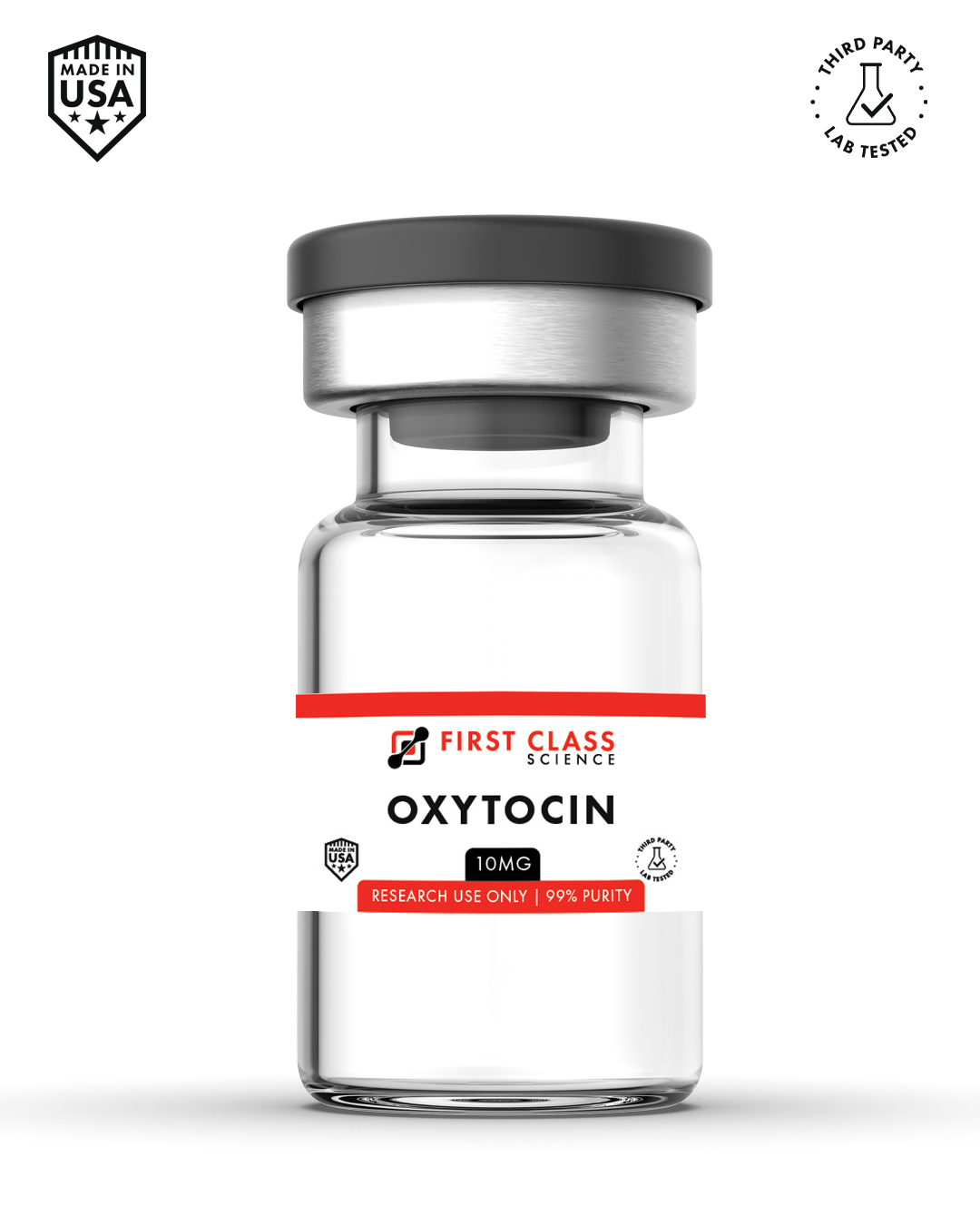
Oxytocin – 10mg
10mg lyophilized vial. Oxytocin is a naturally occurring cyclic peptide hormone studied in research on social-bonding, stress-axis, and central-nervous-system signaling models. Supplied at research-grade purity for laboratory use only.
$200.00
Researchers who buy Oxytocin research peptide are typically studying its behavior as an evolutionarily conserved nonapeptide produced by hypothalamic neurons, acting on the oxytocin receptor (OXTR), a G-protein-coupled receptor encoded on chromosome 3p25. Oxytocin has one of the most substantial published research records of any compound in this catalog, spanning obstetric pharmacology, social-neuroscience, and psychiatric-research contexts. The summary below reflects the published preclinical and clinical literature and is provided strictly for research and educational reference — it does not describe an intended effect of this product in humans or animals.
In this reference:
- What Is Oxytocin?
- Proposed Mechanism of Action
- Chemical Identity
- Purity, Storage & Quality
- Research Applications
- What the Human Evidence Shows
- Frequently Asked Questions
What Is Oxytocin?
Oxytocin is a naturally occurring nonapeptide hormone, synthesized primarily by magnocellular and parvocellular neurons in the paraventricular and supraoptic nuclei of the hypothalamus. Researchers should be aware that oxytocin has a distinct regulatory history from most compounds in this catalog: a pharmaceutical formulation (marketed generically and under brand names including Pitocin) is FDA-approved for specific obstetric indications, including labor induction and management of postpartum hemorrhage. That approval history is referenced here for research context only and applies to a distinct, controlled pharmaceutical product administered under clinical supervision — it is entirely separate from the research-use-only oxytocin sold on this page, which describes the published pharmacology and social/behavioral-neuroscience research literature on the molecule.
Proposed Mechanism of Action
Oxytocin acts as an agonist at the oxytocin receptor (OXTR), a G-protein-coupled receptor. Beyond its well-established peripheral role in uterine smooth-muscle contraction and milk-ejection reflex (the basis for its obstetric pharmaceutical use), published social-neuroscience research has extensively examined oxytocin’s central nervous system signaling. A landmark controlled human study reported that intranasal oxytocin administration produced a substantial increase in trust behavior in an economic-exchange paradigm, with study authors proposing that oxytocin specifically affects willingness to accept social risk in interpersonal interactions rather than risk tolerance generally (Kosfeld M, et al., Nature. 2005;435(7042):673-6; PMID 15931222).
Separate published research in monogamous prairie voles found that variation in OXTR receptor density in the nucleus accumbens is associated with pair-bonding behavior, and genetic-association research has linked human OXTR gene variation to pair-bonding and broader social-behavior measures (PMID 22015110). These cross-species comparative findings are a major reason oxytocin/OXTR signaling remains an active research area in behavioral neuroscience.
Chemical Identity
| Structure | Cyclic nonapeptide (disulfide bridge) |
| Molecular Formula | C43H66N12O12S2 |
| Molecular Weight | ~1007.2 g/mol |
| Sequence Length | 9 amino acids (nonapeptide) |
| Appearance | White to off-white lyophilized powder |
Purity, Storage & Quality
First Class Science supplies this Oxytocin research peptide vial at research-grade purity, verified by independent third-party HPLC testing and mass spectrometry. A Certificate of Analysis is available for every batch at our Certificate of Analysis page, listing the specific lot’s purity result, molecular-weight confirmation, and test date.
Store the lyophilized (freeze-dried) compound at −20°C for long-term stability. This vial must be reconstituted with bacteriostatic or sterile water before laboratory use; after reconstitution, refrigerate at 2–8°C and use within 4–6 weeks. Avoid repeated freeze-thaw cycles and prolonged exposure to light or room-temperature conditions, both of which are associated with accelerated peptide degradation in handling literature.
Important: This item is manufactured strictly for research purposes. It is not intended for human or veterinary use and is distributed solely for laboratory and scientific investigation.
Preparing Solutions for Laboratory Use
Laboratories reconstituting lyophilized Oxytocin for in vitro or animal-model research typically follow standard peptide-handling practice: the vial is brought to room temperature before opening, and a diluent — commonly reconstitution solution or sterile water for injection (SWFI) — is added slowly down the interior wall of the vial rather than directly onto the lyophilized material, to reduce foaming and mechanical stress on the peptide. The vial is then gently swirled, never shaken, until the powder is fully dissolved.
Stock-solution concentration for a given protocol is calculated by dividing the total peptide mass in the vial by the volume of diluent added, and that calculation should be recorded in the study’s protocol documentation. This page describes general laboratory reconstitution practice for research use and is not a dosing guide for human or animal administration.
Quality Control Methodology
Each production batch of this Oxytocin research peptide undergoes independent third-party testing before release. High-performance liquid chromatography (HPLC) confirms purity by measuring the proportion of the target peptide relative to synthesis by-products or degradation fragments. Mass spectrometry separately confirms molecular identity, verifying that the measured mass of the material matches the expected ~1007.2 g/mol molecular weight of Oxytocin. Both results are recorded on the batch’s published Certificate of Analysis, letting researchers independently verify identity and purity rather than relying on manufacturer claims alone.
Who Should Buy Oxytocin Research Peptide
Researchers who buy Oxytocin from First Class Science are typically university and academic laboratories, contract research organizations (CROs), and biotechnology R&D teams running in vitro OXTR receptor-binding assays or animal/human-model studies on social-neuroscience and behavioral-pharmacology research. First Class Science requires that all research-peptide orders be placed by parties who acknowledge and agree to the research-use-only terms stated on this page prior to purchase.
Research Applications
The published literature on oxytocin spans several distinct research areas. Each is summarized below strictly as a description of what has been studied in animal, in vitro, or controlled clinical-trial models — not as a claim about effects for any individual using this product.
Social Trust and Behavioral-Economics Research
The Kosfeld et al. (2005) study established a controlled experimental paradigm for studying oxytocin’s effects on trust and social-risk-taking behavior in humans, remaining a foundational reference for the field.
Pair-Bonding and Comparative Neuroscience Research
Cross-species research comparing monogamous and non-monogamous vole species has examined OXTR receptor density as a correlate of pair-bonding behavior, and human genetic-association research has extended these findings to OXTR gene variation and human social behavior (PMID 22015110).
Peripheral Physiology Research (Obstetric Pharmacology)
Oxytocin’s well-established peripheral role in uterine contraction and milk-ejection reflex is the basis for its FDA-approved pharmaceutical use, referenced here as research context distinct from the central-nervous-system social-neuroscience literature discussed above.
What the Human Evidence Shows
Researchers evaluating oxytocin should know that it has an unusually extensive published human evidence base for a research peptide, spanning both its long-established peripheral obstetric pharmacology (supporting its FDA-approved Pitocin formulation) and a large, separate body of controlled human behavioral-neuroscience research using intranasal administration, including the Kosfeld et al. trust study cited above. Published reviews have also examined a substantial number of clinical trials investigating intranasal oxytocin in psychiatric-research contexts including autism spectrum disorder, depression, and addiction research.
Researchers must clearly distinguish these two evidence bases from the research-use-only material sold on this page: the FDA-approved obstetric formulation (Pitocin) is a distinct, clinically-supervised pharmaceutical product; the behavioral-neuroscience research literature, while extensive and published in high-impact journals, generally reflects controlled research-study administration, not an approved therapeutic indication for social/behavioral effects. Oxytocin as supplied here for research use is not evaluated by the FDA for any use outside the approved obstetric product, and this research-use-only sale does not support human self-administration for any purpose.
Common Research Study Designs
Published studies referenced throughout this page typically fall into three designs: controlled human behavioral-economics/social-cognition trials using intranasal administration; comparative animal studies (particularly prairie vole pair-bonding research) examining OXTR receptor density and social behavior; and human genetic-association studies linking OXTR gene variation to behavioral phenotypes. Understanding which design underlies a given finding is important context for interpreting the strength of any individual claim in the literature.
Frequently Asked Questions
What is the purity of this Oxytocin research peptide?
Every batch is independently verified via third-party HPLC and mass-spectrometry testing, with a Certificate of Analysis published for each lot.
How should Oxytocin research peptide be stored?
Store the lyophilized powder at −20°C. After reconstitution, refrigerate at 2–8°C and use within 4–6 weeks; avoid repeated freeze-thaw cycles.
Is Oxytocin approved for human or animal use?
A distinct pharmaceutical formulation (Pitocin) is FDA-approved for specific obstetric indications. That approval applies to the clinically-supervised pharmaceutical product only — not to the research-grade oxytocin sold on this page, which is distributed strictly for laboratory research use.
Has oxytocin been tested in humans at all?
Yes, extensively, in two distinct contexts: long-established obstetric pharmacology (supporting FDA approval) and a large body of controlled behavioral-neuroscience research using intranasal administration (e.g., PMID 15931222). Researchers should describe each accurately according to its own study design and regulatory context.
What is the proposed mechanism of Oxytocin in research models?
Oxytocin binds the oxytocin receptor (OXTR), a G-protein-coupled receptor, mediating both peripheral effects (uterine contraction, milk ejection) and central nervous system effects studied in social-neuroscience research (trust, pair-bonding).
What does the Certificate of Analysis show?
The Certificate of Analysis published for each batch shows the HPLC purity result, mass-spectrometry molecular-weight confirmation, lot number, and test date, allowing researchers to independently verify the identity and purity of the specific batch they receive.
Can Oxytocin research peptide be shipped internationally?
Shipping availability and any import restrictions for research peptides vary by destination country and are subject to change; researchers should confirm their local import regulations for research-use-only compounds before ordering.
Shipping, Handling & Compliance
This Oxytocin research peptide ships as a lyophilized powder in a sealed glass vial, packaged to maintain cold-chain integrity in transit where applicable. All orders are subject to the research-use-only terms stated on this page, and First Class Science does not sell this or any other research peptide for human or veterinary administration under any circumstance.
Order tracking, batch-specific documentation requests, and general product questions can be directed to First Class Science customer support, which can confirm current lead times and any destination-specific documentation a receiving institution may require for its own compliance records.
Disclaimer: The research summarized above is drawn from third-party published studies conducted in human or animal contexts. It is provided for research and educational reference only and does not describe an intended use, effect, or benefit of this product for any person or animal.
⊗ ALL ITEMS ARE SOLD FOR RESEARCH USE ONLY. This category covers strictly in vitro laboratory testing and scientific experimentation. Content on this site is for education only and does not authorize human or animal use of any kind, which is prohibited by law. Only trained, licensed professionals should handle these materials. Nothing sold here qualifies as a drug, food, or cosmetic, and none of it may be labeled, advertised, or used as such.