

Product Usage: For Research Use Only – Not for Human or Veterinary Use
This product is not a drug, food, cosmetic, or dietary supplement and has not been evaluated by the FDA. It is strictly intended for in vitro research by qualified professionals. Any use in humans or animals is strictly prohibited and may violate federal, state, or local laws, including the Federal Food, Drug, and Cosmetic Act. No therapeutic or diagnostic application is implied or permitted. The purchaser assumes all responsibility for compliance with applicable regulations.
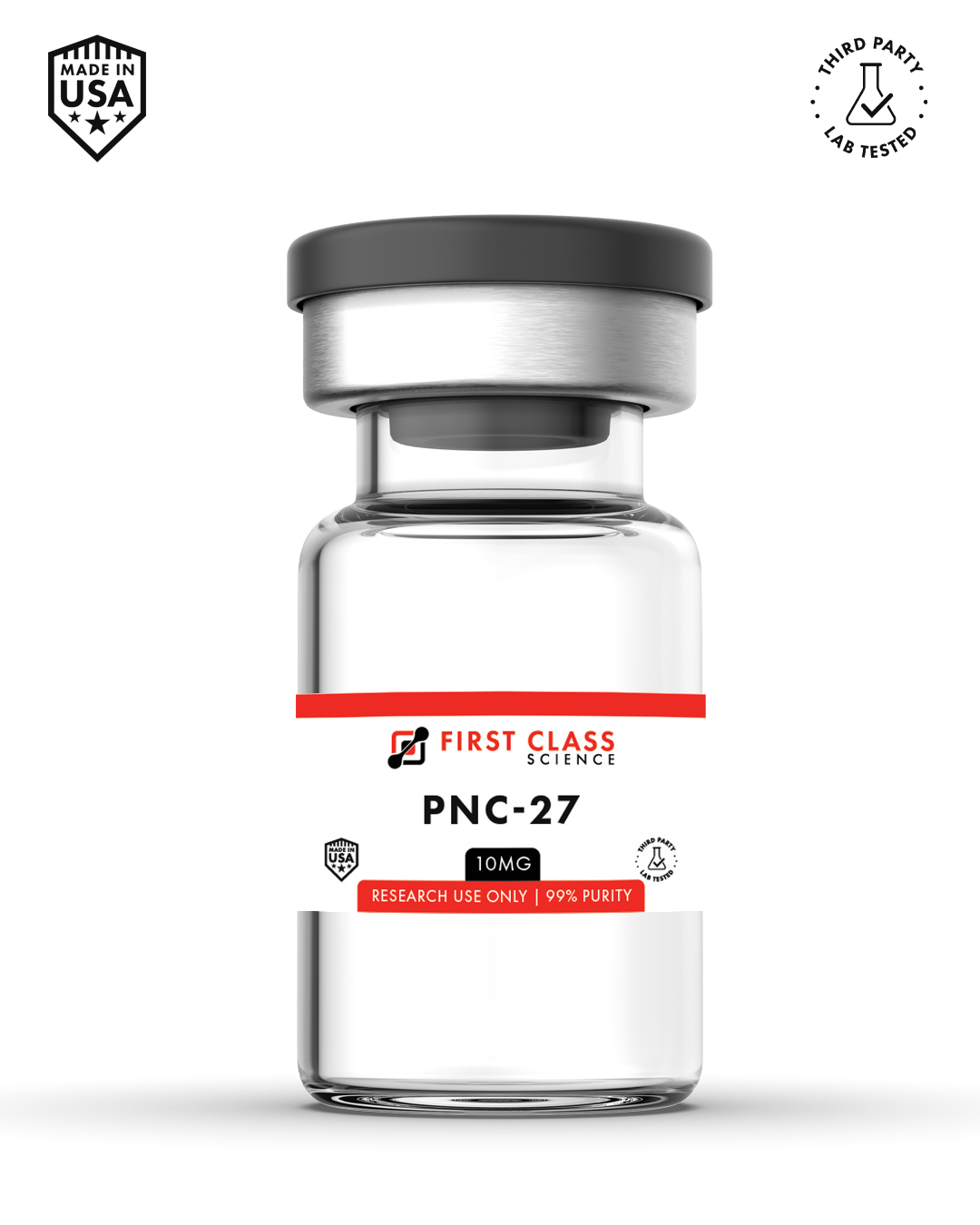
PNC-27 – 10mg
10mg – Lyophilized MUST BE RECONSTITUTED PNC-27 is a synthetic peptide derived from a segment of the p53 protein, studied in preclinical research for its interaction with HDM-2 and cell-membrane signaling pathways in cancer-cell models. Supplied at research-grade purity for laboratory use only.
$150.00
PNC-27 is a synthetic chimeric peptide combining a 15-residue fragment of the p53 tumor-suppressor protein’s HDM-2-binding domain with a membrane-penetrating “leader” sequence. Published research has examined PNC-27’s interaction with the HDM-2 protein and its association with selective membrane-pore formation in cancer-cell models. The summary below reflects the published literature and is provided for research reference only — it does not describe intended effects of this product in humans or animals.
Product Details
- What is PNC-27?
- PNC-27 Structure
- PNC-27 Research
What is PNC-27?
PNC-27 combines residues 12–26 of the HDM-2-binding domain of the p53 protein with a membrane residency peptide (MRP) sequence that transports attached peptides across cell membranes. Researchers designed this construct to bring the p53-derived HDM-2-binding sequence into direct contact with HDM-2 protein located at the plasma membrane of cancer cells — a localization reported in prior research to be elevated in cancer cells relative to normal cells.
Published in vitro research describes PNC-27’s binding to membrane-associated HDM-2 as inducing formation of pores in the cancer-cell membrane, a process study authors report leads to cell lysis and necrosis in the cancer-cell lines tested, while normal cells in the same experiments were reported to be comparatively unaffected.
Chemical Identity
PNC-27’s defined molecular structure and characterized physical properties make it a well-documented candidate for laboratory research.
CAS Number: 1159861-00-3
Purity & Quality
First Class Science supplies PNC-27 at research-grade purity for laboratory and experimental use. Every production batch is tested to confirm identity and purity, with a Certificate of Analysis available per batch at https://firstclassscience.com/certificate-of-analysis/. Store lyophilized compound at −20°C for long-term stability; refrigerate at 2–8°C after reconstitution and use within 4–6 weeks.
Important: This item is manufactured strictly for research purposes. It is not intended for human or veterinary use and is distributed solely for laboratory and scientific investigation.
PNC-27 Structure
Chemical Structure
Sequence: Pro-Pro-Leu-Ser-Gln-Glu-Thr-Phe-Ser-Asp-Leu-Trp-Lys-Leu-Leu-Lys-Lys-Trp-Lys-Met-Arg-Arg-Asn-Gln-Phe-Trp-Val-Lys-Val-Gln-Arg-Gly.
Chemical Properties
| CAS Number | 1159861-00-3 |
| Molecular Formula | C188H293N53O44S |
| Molecular Weight | ~4,031.7 g/mol |
PNC-27 Research
Research Applications
Cancer-Cell Membrane & HDM-2 Research
Published research (Sarafraz-Yazdi et al.) examined PNC-27’s structural binding to HDM-2 in a p53-peptide-like conformation and reported that this binding induced selective pore formation in cancer-cell membranes, leading to lysis and necrosis of the cancer cells studied while sparing normal cells in the same experiments. Additional preclinical research has extended this membrane-pore mechanism to models of pancreatic cancer and leukemia cell lines, with study authors reporting reduced cancer-cell viability following PNC-27 exposure in these tested models.
Sources
- Sarafraz-Yazdi E, et al. “Anticancer peptide PNC-27 adopts an HDM-2/p53-like structure and kills cancer cells by binding to HDM-2 in their membranes.” Proc Natl Acad Sci U S A. 2010;107(5):1918-1923.
Disclaimer: The research summarized above is drawn from third-party published studies conducted in animal, in vitro, or non-U.S. clinical contexts. It is provided for research and educational reference only and does not describe an intended use, effect, or benefit of this product for any person or animal.
⊗ ALL ITEMS ARE SOLD FOR RESEARCH USE ONLY. This category covers strictly in vitro laboratory testing and scientific experimentation. Content on this site is for education only and does not authorize human or animal use of any kind, which is prohibited by law. Only trained, licensed professionals should handle these materials. Nothing sold here qualifies as a drug, food, or cosmetic, and none of it may be labeled, advertised, or used as such.