

Product Usage: For Research Use Only – Not for Human or Veterinary Use
This product is not a drug, food, cosmetic, or dietary supplement and has not been evaluated by the FDA. It is strictly intended for in vitro research by qualified professionals. Any use in humans or animals is strictly prohibited and may violate federal, state, or local laws, including the Federal Food, Drug, and Cosmetic Act. No therapeutic or diagnostic application is implied or permitted. The purchaser assumes all responsibility for compliance with applicable regulations.
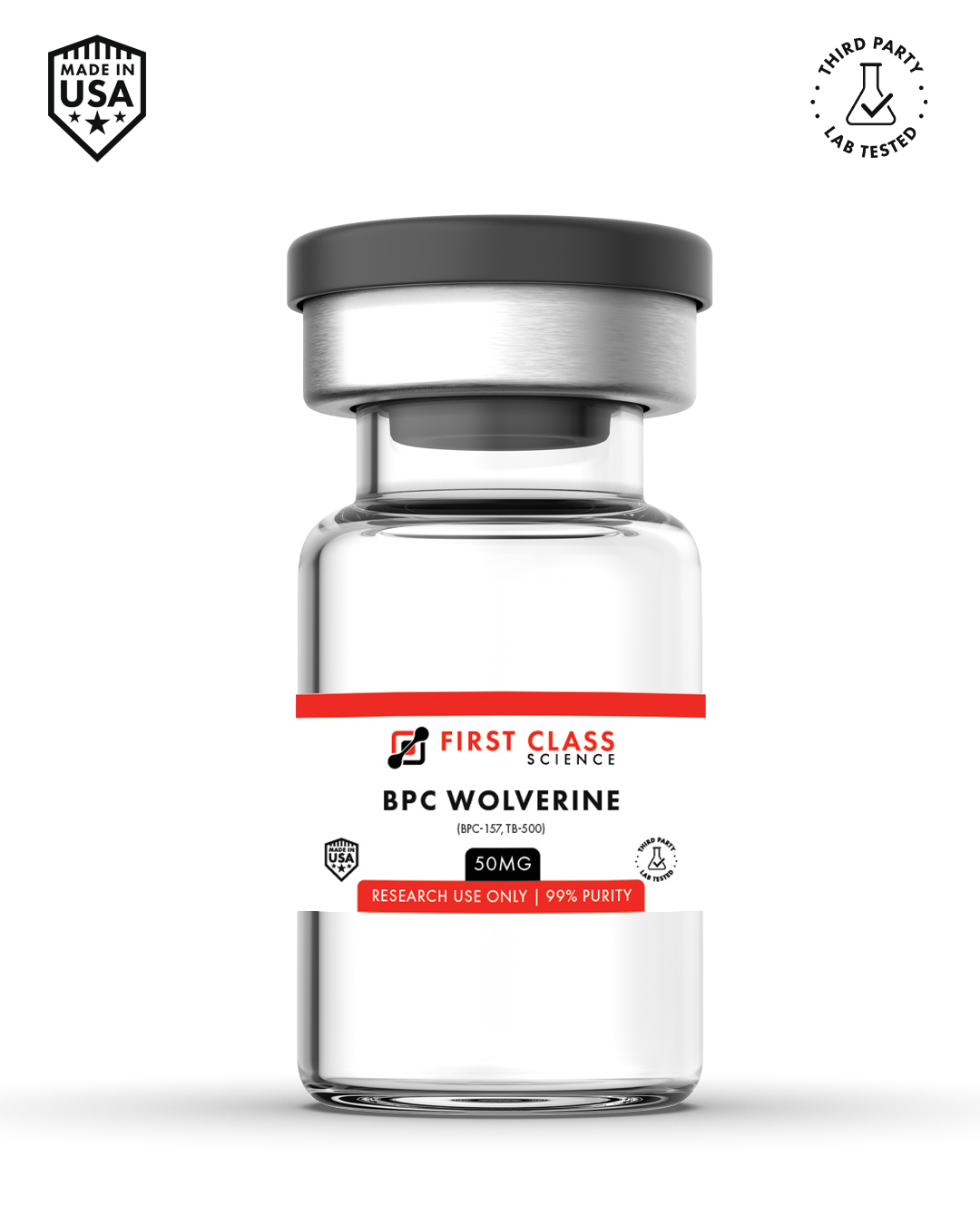
BPC Wolverine – 12.5mg
12.5mg lyophilized vial of BPC-157, branded as “BPC Wolverine.” BPC-157 is a synthetic peptide studied extensively in animal models of tissue and gastrointestinal research. Supplied at research-grade purity for laboratory use only.
$200.00
BPC Wolverine is First Class Science’s branded name for BPC-157 — the product name references the peptide’s reputation in research circles rather than indicating any additional or undisclosed ingredient; this listing contains BPC-157 only. BPC-157 is a synthetic peptide derived from a partial sequence identified in gastric-juice protein research, studied extensively in animal models of tissue-repair and gastrointestinal signaling pathways.
Product Details
- What is BPC-157?
- Chemical Identity
- BPC-157 Research
What is BPC-157?
BPC-157 is a synthetic peptide fragment derived from a body-protection compound originally identified in gastric juice. Researchers have studied its interaction with cellular signaling pathways relevant to tissue and gastrointestinal biology across a substantial body of preclinical literature, much of it produced by a single long-running research group.
Chemical Identity
| CAS Number | 137525-51-0 |
| Molecular Formula | C62H98N16O22 |
| Molecular Weight | 1419.53 g/mol |
Purity & Quality
First Class Science supplies BPC Wolverine at 99% purity, verified by independent third-party HPLC testing and mass spectrometry. A Certificate of Analysis is available for every batch at https://firstclassscience.com/certificate-of-analysis/. Store lyophilized compound at −20°C for long-term stability; refrigerate at 2–8°C after reconstitution and use within 4–6 weeks.
Important: This item is manufactured strictly for research purposes. It is not intended for human or veterinary use and is distributed solely for laboratory and scientific investigation.
BPC-157 Research
Research Applications
Gastrointestinal Research Models
Published research in animal models has examined BPC-157’s relationship to gastric-ulcer healing and gastrointestinal-lesion recovery, with study authors reporting protective effects on gastric-mucosal markers in tested subjects relative to untreated controls. Researchers use these models to study mucosal-repair pathway signaling.
Tendon, Ligament & Muscle Research
Animal-model research has examined BPC-157’s association with tendon-to-bone healing, ligament-repair markers, and muscle-injury recovery, with study authors reporting accelerated healing indicators in tested models compared to controls. This line of research has made BPC-157 a frequently used tool compound in tissue-repair-pathway studies.
Cellular Signaling & Angiogenesis Research
In vitro and animal studies have examined BPC-157’s relationship to markers of blood-vessel formation (angiogenesis) and cell-migration pathways, with researchers proposing that these effects contribute to the tissue-repair patterns observed across the broader body of BPC-157 research.
Disclaimer: The research summarized above is drawn from third-party published studies conducted in animal, in vitro, or non-U.S. clinical contexts. It is provided for research and educational reference only and does not describe an intended use, effect, or benefit of this product for any person or animal.
⊗ ALL ITEMS ARE SOLD FOR RESEARCH USE ONLY. This category covers strictly in vitro laboratory testing and scientific experimentation. Content on this site is for education only and does not authorize human or animal use of any kind, which is prohibited by law. Only trained, licensed professionals should handle these materials. Nothing sold here qualifies as a drug, food, or cosmetic, and none of it may be labeled, advertised, or used as such.