

Product Usage: For Research Use Only – Not for Human or Veterinary Use
This product is not a drug, food, cosmetic, or dietary supplement and has not been evaluated by the FDA. It is strictly intended for in vitro research by qualified professionals. Any use in humans or animals is strictly prohibited and may violate federal, state, or local laws, including the Federal Food, Drug, and Cosmetic Act. No therapeutic or diagnostic application is implied or permitted. The purchaser assumes all responsibility for compliance with applicable regulations.
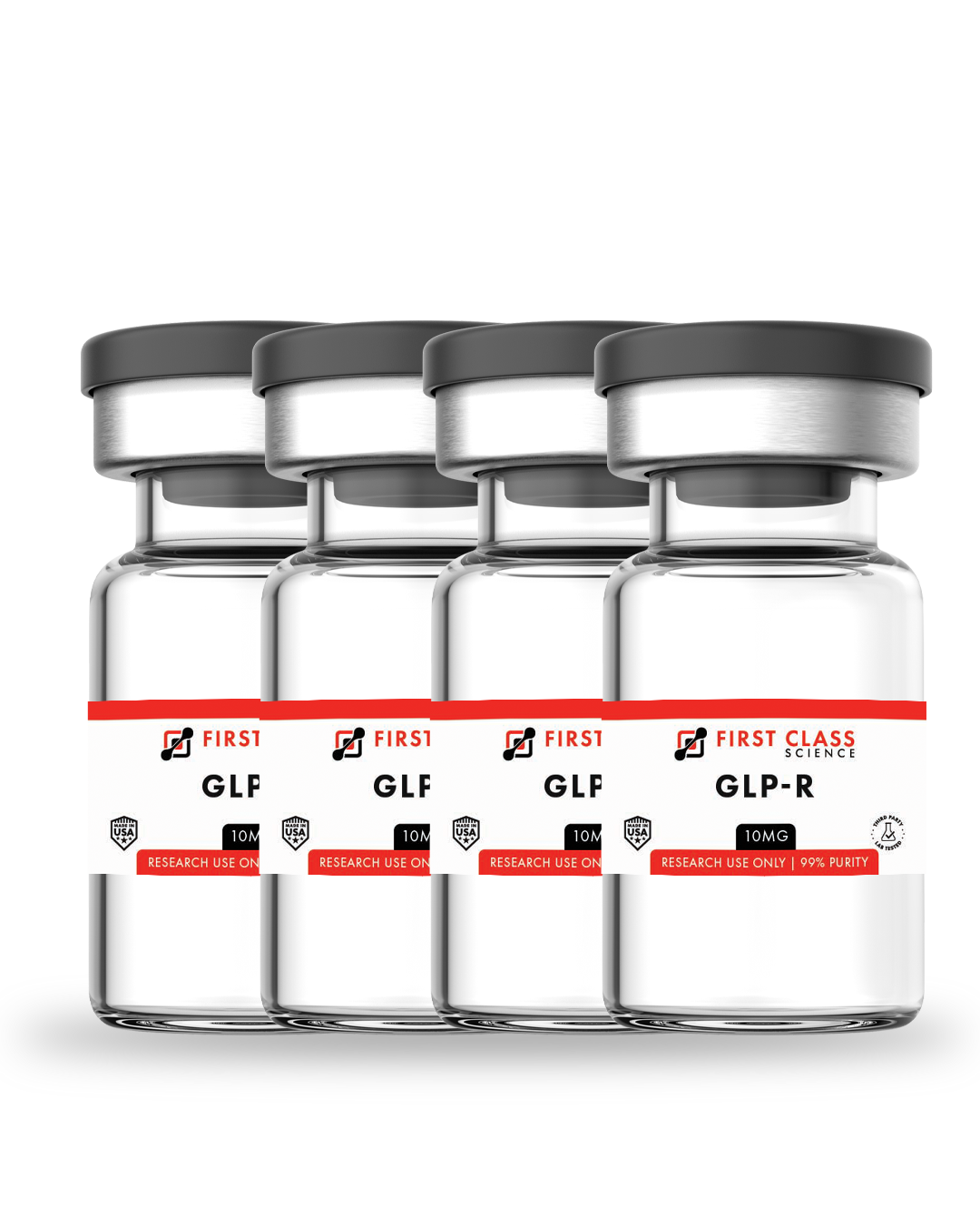
GLP-R x 4 Single Dose Vials
Reconstituted at 60mg / 2mL per vial (4-vial set). GLP-R is a synthetic triple-hormone-receptor peptide studied in preclinical and early clinical research for its interaction with GLP-1, GIP, and glucagon receptor pathways relevant to metabolic and body-weight regulation. Supplied at research-grade purity for laboratory use only.
Price range: $450.00 through $750.00
GLP-R is First Class Science’s research code for retatrutide, a synthetic unimolecular peptide engineered to act at three distinct metabolic hormone receptors simultaneously. Published research has examined its receptor-binding pharmacology in vitro and its effects on body weight and metabolic markers in a published Phase 2 clinical trial. The summary below reflects the published literature and is provided for research reference only — it does not describe intended effects of this product in humans or animals.
Product Details
- What is GLP-R?
- GLP-R Structure
- GLP-R Research
What is GLP-R?
GLP-R (retatrutide, research code LY3437943) is a synthetic 39-amino-acid peptide built on a GIP-based backbone and modified with two fatty-acid side chains to extend its circulating half-life. Researchers designed the molecule as a “triple agonist,” meaning it is engineered to activate the GLP-1 receptor, the GIP (glucose-dependent insulinotropic polypeptide) receptor, and the glucagon receptor in a single compound, rather than the single- or dual-receptor activity seen in earlier incretin-class research peptides.
Preclinical pharmacology research describes balanced activity across all three receptors as the basis for the compound’s studied effects on energy intake, energy expenditure, and glucose-handling pathways in tested models. Researchers have proposed that combining glucagon-receptor activity — associated in prior research with increased energy expenditure and lipid metabolism — with GLP-1 and GIP receptor activity may produce additive effects on body-weight-related endpoints relative to single-receptor incretin research compounds, though this remains an active area of investigation.
Chemical Identity
GLP-R (retatrutide) has a defined molecular structure characterized in the peer-reviewed and regulatory literature.
CAS Number: 2381089-83-2
Purity & Quality
First Class Science supplies GLP-R at research-grade purity for laboratory and experimental use. Every production batch is tested to confirm identity and purity, with a Certificate of Analysis available per batch at https://firstclassscience.com/certificate-of-analysis/.
Important: This item is manufactured strictly for research purposes. It is not intended for human or veterinary use and is distributed solely for laboratory and scientific investigation.
GLP-R Structure
Chemical Structure
2D and 3D structure renderings are available via the compound’s public PubChem record (CID 171390338).
Chemical Properties
| CAS Number | 2381089-83-2 |
| Molecular Formula | C221H342N46O68 |
| Molecular Weight | ~4,731.3 g/mol |
Full compound data: PubChem CID 171390338 (pubchem.ncbi.nlm.nih.gov/compound/171390338)
GLP-R Research
Research Applications
Metabolic & Body-Weight Research
A published Phase 2 clinical trial (Jastreboff et al., 2023, New England Journal of Medicine) examined retatrutide across a range of doses in adults with obesity over 48 weeks, reporting dose-dependent reductions in body weight relative to placebo in the study population, alongside changes in waist circumference and several cardiometabolic markers monitored as secondary endpoints. Separate preclinical characterization research (Coskun et al., published pharmacology literature) described the compound’s receptor-binding profile across GLP-1, GIP, and glucagon receptors and its effects on food intake and energy expenditure measures in tested animal models, which study authors proposed as the mechanistic basis for the effects observed in later human trial research. Researchers note this remains an active and evolving area of clinical investigation, with additional trials in progress.
Sources
- Jastreboff AM, et al. “Triple-Hormone-Receptor Agonist Retatrutide for Obesity — A Phase 2 Trial.” N Engl J Med. 2023;389(6):514-526.
Disclaimer: The research summarized above is drawn from third-party published studies conducted in animal, in vitro, or non-U.S. clinical contexts. It is provided for research and educational reference only and does not describe an intended use, effect, or benefit of this product for any person or animal.
⊗ ALL ITEMS ARE SOLD FOR RESEARCH USE ONLY. This category covers strictly in vitro laboratory testing and scientific experimentation. Content on this site is for education only and does not authorize human or animal use of any kind, which is prohibited by law. Only trained, licensed professionals should handle these materials. Nothing sold here qualifies as a drug, food, or cosmetic, and none of it may be labeled, advertised, or used as such.