

Product Usage: For Research Use Only – Not for Human or Veterinary Use
This product is not a drug, food, cosmetic, or dietary supplement and has not been evaluated by the FDA. It is strictly intended for in vitro research by qualified professionals. Any use in humans or animals is strictly prohibited and may violate federal, state, or local laws, including the Federal Food, Drug, and Cosmetic Act. No therapeutic or diagnostic application is implied or permitted. The purchaser assumes all responsibility for compliance with applicable regulations.
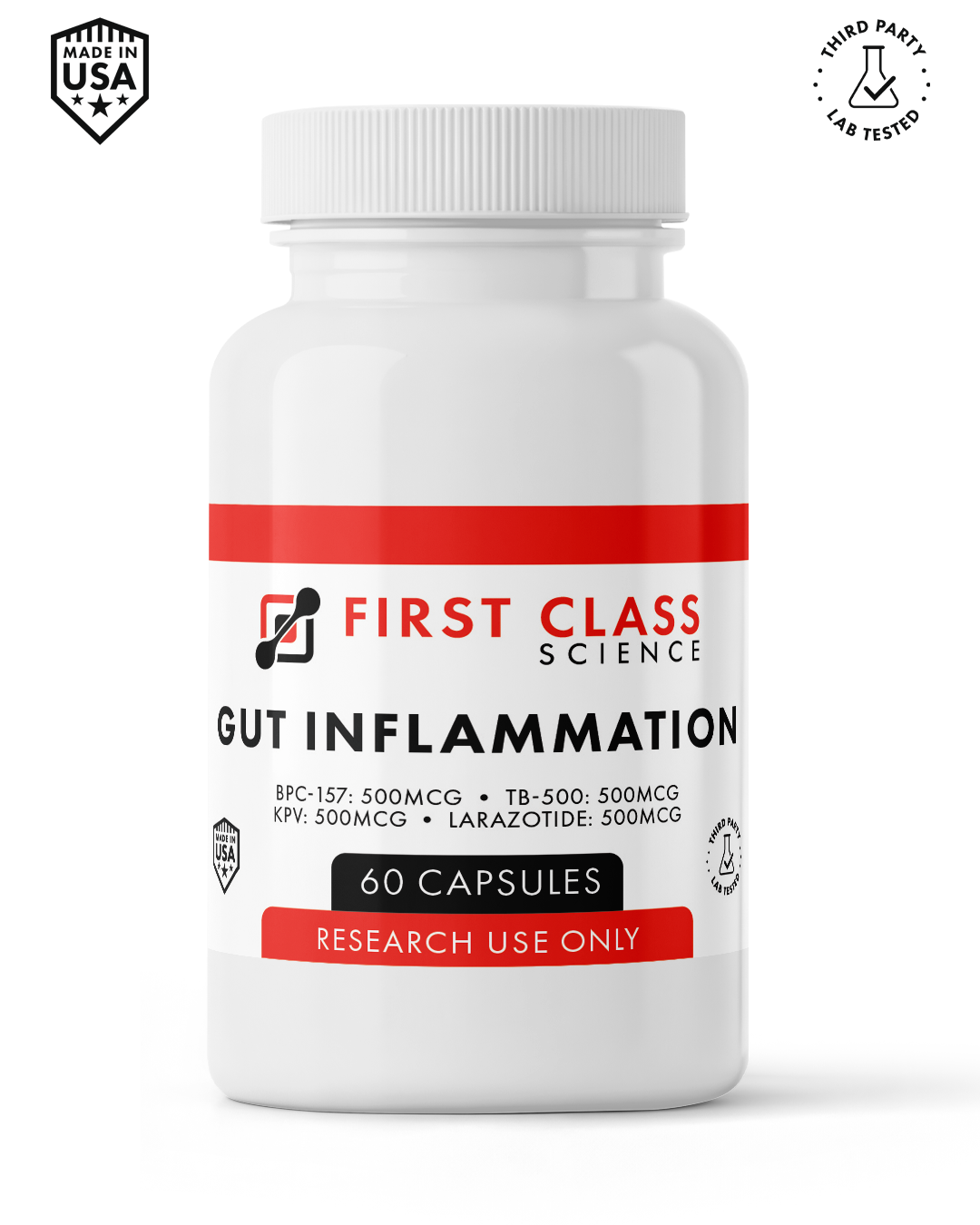
Gut Inflammation Capsules
Gut Inflammation Capsules — a 2mg blend of BPC-157, TB-500, KPV, and Larazotide (500mcg each). Each component is independently studied in published research for its relevance to gastrointestinal tissue, gut-barrier, or inflammation-related models. Supplied at research-grade purity for laboratory use only.
$300.00
Each capsule contains a 2mg blend of four peptides — BPC-157, TB-500, KPV, and Larazotide (500mcg each) — studied independently across different areas of gastrointestinal and inflammation-related research. Each component is described below; no published study has examined this specific four-peptide combination as a single studied entity.
Product Details
- What is BPC-157?
- What is TB-500?
- What is KPV?
- What is Larazotide?
- Chemical Identity
- Research Applications
What is BPC-157?
BPC-157 is a synthetic pentadecapeptide corresponding to a partial sequence of a protein reported to occur naturally in human gastric juice. Preclinical animal research has examined its relevance to gastric and intestinal ulcer-healing models.
What is TB-500?
TB-500 is a name used commercially for a synthetic version of Thymosin Beta-4 (Tβ4), a naturally occurring 43-amino-acid peptide involved in actin regulation within cells. Preclinical research has examined Tβ4/TB-500’s relevance to cell migration and tissue-repair models, including gut-lining and wound-healing research.
What is KPV?
KPV (Lys-Pro-Val) is a synthetic tripeptide corresponding to the C-terminal fragment (residues 11-13) of alpha-melanocyte-stimulating hormone (α-MSH). Research has examined KPV’s anti-inflammatory activity in cell and animal models independent of classical melanocortin-receptor binding, including in models of intestinal inflammation.
What is Larazotide?
Larazotide (also known as AT-1001) is a synthetic octapeptide (Gly-Gly-Val-Leu-Val-Gln-Pro-Gly) studied as an antagonist of zonulin signaling and a regulator of intestinal tight-junction permeability. It has been evaluated in published Phase 2/3 clinical trials, primarily in the context of celiac-disease-related gut-permeability research.
| BPC-157 — CAS Number | 137525-51-0 |
| BPC-157 — Molecular Formula | C62H98N16O22 |
| BPC-157 — Molecular Weight | 1419.6 g/mol |
| TB-500 (Thymosin Beta-4) — CAS Number | 77591-33-4 |
| TB-500 — Molecular Formula | C212H350N56O78S |
| TB-500 — Molecular Weight | ≈4963.4 g/mol |
| KPV — CAS Number | 67727-97-3 |
| KPV — Molecular Formula | C16H30N4O4 |
| KPV — Molecular Weight | ≈342.4 g/mol |
| Larazotide — CAS Number | 258818-34-7 |
Purity & Quality
First Class Science supplies this blend at research-grade (99%) purity, verified by independent third-party HPLC testing and mass spectrometry. A Certificate of Analysis is available for every batch at https://firstclassscience.com/certificate-of-analysis/.
Storage: Store in a cool, dry place away from direct sunlight and moisture. Keep out of reach of children.
Important: This item is manufactured strictly for research purposes. It is not intended for human or veterinary use and is distributed solely for laboratory and scientific investigation.
Research Applications
BPC-157 & TB-500 — Gut-Lining & Tissue-Repair Research
Animal-model research has examined both BPC-157 and Thymosin Beta-4/TB-500 in gastrointestinal ulcer and tissue-injury models, reporting effects on markers of mucosal healing, angiogenesis-related signaling, and cell-migration activity in the tissue models tested. Study authors note this literature originates predominantly from a small number of research groups and warrants independent replication.
KPV — Anti-Inflammatory Research
Cell and animal-model research has examined KPV’s effect on inflammatory cytokine production and markers of intestinal inflammation, including in colitis-model research, reporting reduced inflammatory markers in tested models independent of classical α-MSH melanocortin-receptor engagement.
Larazotide — Gut-Barrier & Permeability Research
Published clinical trials have examined larazotide’s effect on intestinal permeability measures and gastrointestinal symptom scores in study populations with celiac disease exposed to gluten, reporting reduced permeability and symptom measures relative to placebo in some of the trials conducted. Study authors describe larazotide as a zonulin-pathway tight-junction regulator rather than an anti-inflammatory agent in the classical sense.
Combined Use in Research Settings
Researchers combine peptides addressing complementary gut-related pathways — tissue repair (BPC-157, TB-500), inflammatory signaling (KPV), and barrier permeability (Larazotide) — to study multiple aspects of gastrointestinal biology in parallel; the four-peptide combination itself has not been the subject of a published study.
Disclaimer: The research summarized above is drawn from third-party published studies conducted in animal, in vitro, or non-U.S. clinical contexts. It is provided for research and educational reference only and does not describe an intended use, effect, or benefit of this product for any person or animal.
⊗ ALL ITEMS ARE SOLD FOR RESEARCH USE ONLY. This category covers strictly in vitro laboratory testing and scientific experimentation. Content on this site is for education only and does not authorize human or animal use of any kind, which is prohibited by law. Only trained, licensed professionals should handle these materials. Nothing sold here qualifies as a drug, food, or cosmetic, and none of it may be labeled, advertised, or used as such.