

Product Usage: For Research Use Only – Not for Human or Veterinary Use
This product is not a drug, food, cosmetic, or dietary supplement and has not been evaluated by the FDA. It is strictly intended for in vitro research by qualified professionals. Any use in humans or animals is strictly prohibited and may violate federal, state, or local laws, including the Federal Food, Drug, and Cosmetic Act. No therapeutic or diagnostic application is implied or permitted. The purchaser assumes all responsibility for compliance with applicable regulations.
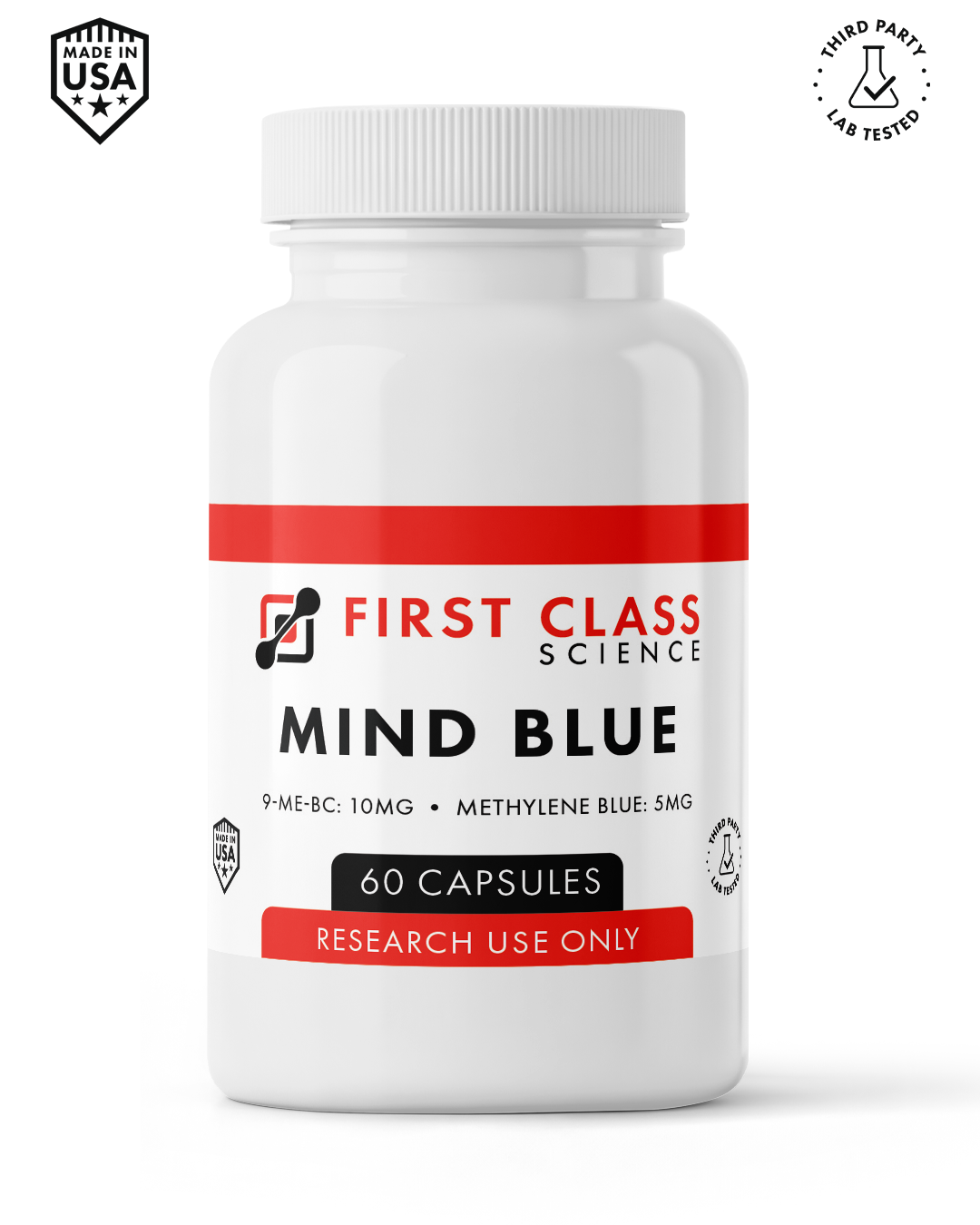
Mind Blue Capsules
Capsule-form blend of 9-ME-BC and Methylene Blue, two compounds studied independently in preclinical research for their interaction with neuronal and mitochondrial signaling pathways. Supplied at research-grade purity for laboratory use only.
$300.00
This advanced formulation combines 9-ME-BC and Methylene Blue, two compounds studied independently in laboratory research for their interaction with cellular and central-nervous-system-related signaling pathways. There is no published research on this specific combination; each component’s research profile below reflects study of that compound individually. This formulation is intended for research use only, and its applications outside of laboratory settings have not been established.
What is Mind Blue Capsules?
This formulation combines 9-ME-BC and Methylene Blue, compounds studied in laboratory research for their interaction with cellular and central nervous system-related signaling pathways. 9-ME-BC is examined for its involvement in pathway-level processes related to monoamine oxidase enzyme activity and neurotrophic-factor expression, while Methylene Blue is studied for its role in electron transfer and mitochondrial-associated pathways. In controlled research environments, researchers study combinations such as this to examine how multiple compounds may engage with interconnected signaling systems across complex biological pathways.
Purity & Quality
First Class Science supplies Mind Blue Capsules at 99% purity, verified by independent third-party HPLC testing and mass spectrometry. A Certificate of Analysis is available for every batch at https://firstclassscience.com/certificate-of-analysis/.
Store in a cool, dry place away from direct sunlight and moisture. Keep out of reach of children.
Important: This item is manufactured strictly for research purposes. It is not intended for human or veterinary use and is distributed solely for laboratory and scientific investigation.
Component Research
9-ME-BC (9-Methyl-β-carboline)
9-ME-BC is a naturally occurring beta-carboline alkaloid studied in early-stage preclinical research for its interaction with monoamine oxidase (MAO) enzymes and neurotrophic-factor signaling.
Chemical Identity
| CAS Number | 2521-07-5 |
Molecular formula and molecular weight are not stated here, as confirmed values could not be verified with confidence; refer to the Certificate of Analysis for batch-specific identity confirmation.
Early enzyme-assay research has reported that 9-ME-BC inhibits monoamine oxidase activity, with reported IC50 values in the low-micromolar range. Separate cell-culture research has reported that the compound stimulated expression of neurotrophic factors by astrocytes, and preclinical animal studies have reported that it supported growth and differentiation of dopaminergic neurons in tested models — findings some researchers have proposed as relevant to future Parkinson’s-related neuroscience research. This literature remains early and preclinical, and researchers describe the findings as preliminary.
Sources
Methylene Blue
Methylene Blue is a well-characterized redox-active compound with a long history of use across several fields; the research summarized here pertains specifically to its mitochondrial and redox-signaling research applications and does not describe any approved or intended use of this product.
Chemical Identity
| CAS Number | 61-73-4 |
| Molecular Formula | C16H18ClN3S |
| Molecular Weight | 319.85 g/mol |
Research has examined Methylene Blue’s function as an alternative mitochondrial electron-transfer carrier, with reported effects on cellular oxygen consumption at low tested concentrations. Additional preclinical research has explored antioxidant activity and neuroprotection-related pathways relevant to aging and neurodegenerative-disease research models.
Disclaimer: The research summarized above is drawn from third-party published studies conducted in animal, in vitro, or non-U.S. clinical contexts. It is provided for research and educational reference only and does not describe an intended use, effect, or benefit of this product for any person or animal.
⊗ ALL ITEMS ARE SOLD FOR RESEARCH USE ONLY. This category covers strictly in vitro laboratory testing and scientific experimentation. Content on this site is for education only and does not authorize human or animal use of any kind, which is prohibited by law. Only trained, licensed professionals should handle these materials. Nothing sold here qualifies as a drug, food, or cosmetic, and none of it may be labeled, advertised, or used as such.