
Product Usage: For Research Use Only – Not for Human or Veterinary Use
This product is not a drug, food, cosmetic, or dietary supplement and has not been evaluated by the FDA. It is strictly intended for in vitro research by qualified professionals. Any use in humans or animals is strictly prohibited and may violate federal, state, or local laws, including the Federal Food, Drug, and Cosmetic Act. No therapeutic or diagnostic application is implied or permitted. The purchaser assumes all responsibility for compliance with applicable regulations.
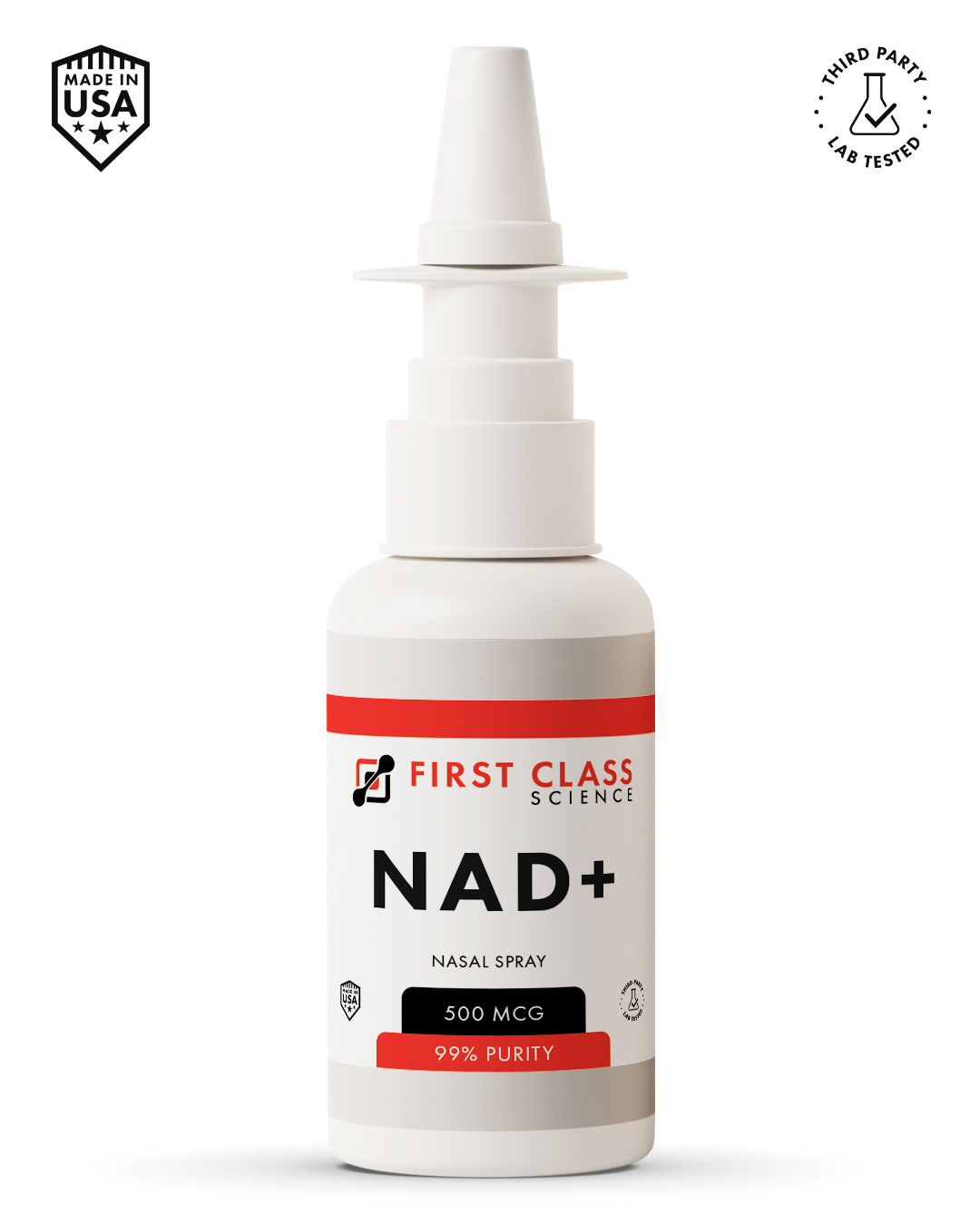
NAD+ Nasal Spray – 4500mg
4500mg nasal spray, supplied lyophilized-free/ready-to-use per label instructions. NAD+ is a coenzyme studied in published research for its relationship to mitochondrial function, cellular energy metabolism, and DNA-repair pathways in laboratory models. Supplied at research-grade purity for laboratory use only.
$200.00
Researchers who buy NAD+ Nasal Spray research material are typically studying nicotinamide adenine dinucleotide (NAD+), one of the most abundant and functionally diverse small molecules in cell biology, formulated here as an intranasal-delivery research preparation. The summary below reflects the published peer-reviewed literature on NAD+ biology and is provided strictly for research and educational reference — it does not describe an intended effect of this product in humans or animals.
In this reference:
- What Is NAD+?
- Proposed Mechanism of Action
- Chemical Identity
- Purity, Storage & Quality
- Research Applications
- What the Human Evidence Shows
- Frequently Asked Questions
What Is NAD+?
NAD+ (nicotinamide adenine dinucleotide, oxidized form) is a dinucleotide present in every living cell across organisms spanning bacteria to mammals, serving two distinct and essential roles: as a redox coenzyme shuttling electrons in glycolysis, the citric acid cycle, and the mitochondrial electron transport chain; and as a consumed substrate for regulatory enzymes — sirtuins, poly(ADP-ribose) polymerases (PARPs), and cyclic ADP-ribose synthases (CD38/CD157) — that use NAD+ hydrolysis to drive gene regulation, DNA repair, and calcium-signaling processes.
The distinction between NAD+’s redox-carrier function (cycling between NAD+ and NADH without net consumption) and its signaling-substrate function (stoichiometric consumption) is central to why total cellular NAD+ levels matter biologically: high enzymatic demand from PARPs or sirtuins can deplete available NAD+ and limit its other functions. This interplay has made NAD+ a central subject of published research into cellular aging, metabolic disease, and mitochondrial biology over the past two decades.
Proposed Mechanism of Action
NAD+’s research significance derives from several interconnected proposed pathways characterized in the peer-reviewed literature. A landmark study demonstrated that the yeast protein Sir2 is an NAD+-dependent histone deacetylase, establishing NAD+ as a required co-substrate — not merely an allosteric regulator — for sirtuin enzyme activity (Imai S, et al., Nature. 2000;403(6771):795-800; PMID 10693811). This positioned mammalian sirtuins (SIRT1-7) as enzymes that sense cellular NAD+ status and translate it into gene-expression and metabolic changes.
Building on this, published research reported that declining nuclear NAD+ in aged mice disrupted nucleus-mitochondria communication via SIRT1-mediated deacetylation of HIF-1α, and that raising NAD+ via a precursor compound restored mitochondrial-function measures in aged mice to levels resembling younger animals in that tested model (Gomes AP, et al., Cell. 2013;155(7):1624-1638; PMID 24360282). Separate published research has characterized PARP-1’s role as the primary nuclear NAD+-consuming enzyme during genotoxic stress, proposing that sustained PARP-1 activation depletes NAD+, leading to reduced sirtuin activity and downstream mitochondrial dysfunction — a mechanism studied as a potential link between genotoxic stress and metabolic decline in cell and animal models.
Chemical Identity
| Full Name | Nicotinamide Adenine Dinucleotide (oxidized form) |
| Molecular Formula | C21H27N7O14P2 |
| Molecular Weight | ~663.4 g/mol |
| Format | Intranasal-delivery research spray, 4500mg |
Purity, Storage & Quality
First Class Science supplies this NAD+ Nasal Spray research material at research-grade purity, verified by independent third-party HPLC testing and mass spectrometry. A Certificate of Analysis is available for every batch at our Certificate of Analysis page, listing the specific lot’s purity result and test date.
Store away from direct light and heat, at refrigerated temperature (2-8°C) once opened for long-term stability, consistent with standard handling practice for NAD+ preparations, which are documented in the literature to be sensitive to hydrolysis and light-driven degradation.
Important: This item is manufactured strictly for research purposes. It is not intended for human or veterinary use and is distributed solely for laboratory and scientific investigation.
Who Should Buy NAD+ Nasal Spray Research Material
Researchers who buy this NAD+ preparation from First Class Science are typically university and academic laboratories, contract research organizations (CROs), and biotechnology R&D teams running in vitro or animal-model studies on NAD+-dependent sirtuin/PARP signaling, mitochondrial biology, or comparative delivery-format research. First Class Science requires that all research-material orders be placed by parties who acknowledge and agree to the research-use-only terms stated on this page prior to purchase.
Research Applications
The published literature on NAD+ biology spans several distinct research areas. Each is summarized below strictly as a description of what has been studied in animal, in vitro, or controlled clinical-trial models — not as a claim about effects for any individual using this product.
Sirtuin-Deacylation and Gene-Regulation Research
Mammalian sirtuins SIRT1-7 are NAD+-dependent protein deacylases: SIRT1 and SIRT6 (nuclear) regulate gene expression through histone deacetylation, while SIRT3, SIRT4, and SIRT5 (mitochondrial) regulate oxidative metabolism and fatty-acid oxidation. All seven require NAD+ as a stoichiometrically-consumed co-substrate, a relationship first established by the foundational Imai et al. (2000) study cited above.
PARP-Mediated DNA-Repair Research
PARP-1 and PARP-2 detect DNA strand breaks and catalyze poly(ADP-ribose) chain attachment, consuming substantial NAD+ in the process. Published research has documented that sustained PARP activation under high genotoxic stress can deplete cellular NAD+ to levels that impair sirtuin function — a recognized regulatory competition studied extensively in aging-biology research.
Mitochondrial Biogenesis and Nuclear-Mitochondrial Communication Research
NAD+-dependent SIRT1 deacetylation of PGC-1α (a master regulator of mitochondrial biogenesis) has been studied as a mechanism linking NAD+ decline to impaired mitochondrial biogenesis. The Gomes et al. (2013) study cited above provided a mouse-model example of restoring this signaling via NAD+ precursor administration.
Age-Related NAD+ Decline Research
Published research has documented that total cellular NAD+ levels decline significantly with age across multiple tissues in rodent models and in human muscle-biopsy studies, a finding that has driven substantial published research interest in NAD+ and NAD+-precursor administration as research strategies for studying restoration of NAD+ levels in aged tissue models.
What the Human Evidence Shows
Researchers evaluating NAD+ should know that the bulk of the most mechanistically detailed published evidence — the foundational sirtuin-mechanism and nuclear-mitochondrial-communication findings cited above — comes from cell-culture and animal-model (primarily mouse) research, not controlled human clinical trials of NAD+ itself. Published human evidence for age-related NAD+ decline exists in the form of observational muscle-biopsy studies documenting lower NAD+ levels in older versus younger subjects, but controlled interventional human trials specifically examining NAD+ (as distinct from NAD+ precursor compounds such as NMN or NR, which have their own separate published trial literature) remain limited.
NAD+ as supplied in this research-use-only preparation is not an FDA-approved drug for any indication and is not evaluated by the FDA for safety or efficacy in humans or animals. Researchers should characterize findings from this page accordingly in any grant application or protocol design — distinguishing mechanistic cell/animal-model evidence from the more limited human clinical-trial record, and distinguishing NAD+ itself from precursor compounds studied under separate research programs.
Common Research Study Designs
Published studies referenced throughout this page typically fall into three designs: in vitro biochemical and cell-culture assays characterizing sirtuin/PARP enzyme mechanisms; controlled animal-model (primarily mouse) studies measuring NAD+ levels and downstream mitochondrial/metabolic markers; and observational human studies (such as muscle-biopsy comparisons) documenting age-related NAD+ decline. Understanding which design underlies a given finding is important context for interpreting the strength of any individual claim in the literature.
Frequently Asked Questions
What is the purity of this NAD+ Nasal Spray research material?
Every batch is independently verified via third-party HPLC and mass-spectrometry testing, with a Certificate of Analysis published for each lot.
How should NAD+ Nasal Spray research material be stored?
Store away from direct light and heat; refrigerate at 2-8°C once opened for long-term stability, consistent with NAD+’s documented sensitivity to hydrolysis and light-driven degradation.
Is NAD+ approved for human or animal use?
No. This NAD+ research material is not an FDA-approved drug for any indication and is not evaluated by the FDA for safety or efficacy. It is sold exclusively for laboratory research use.
What has been published about NAD+ biology in peer-reviewed journals?
A substantial body of peer-reviewed research has characterized NAD+’s role in sirtuin-dependent gene regulation (PMID 10693811), nuclear-mitochondrial communication and mitochondrial function (PMID 24360282), and PARP-mediated DNA repair, published in journals including Nature and Cell.
Has NAD+ itself been tested in controlled human clinical trials?
Human evidence for NAD+ is more limited than the animal/cell-model literature and consists primarily of observational studies (such as muscle-biopsy comparisons documenting age-related decline). Researchers should distinguish this from the separate, more extensive published trial literature on NAD+ precursor compounds such as NMN and NR.
What does the Certificate of Analysis show?
The Certificate of Analysis published for each batch shows the HPLC purity result and test date, allowing researchers to independently verify the identity and purity of the specific batch they receive.
Can NAD+ Nasal Spray research material be shipped internationally?
Shipping availability and any import restrictions for research materials vary by destination country and are subject to change; researchers should confirm their local import regulations for research-use-only compounds before ordering.
Shipping, Handling & Compliance
This NAD+ Nasal Spray research material ships packaged to maintain stability in transit where applicable. All orders are subject to the research-use-only terms stated on this page, and First Class Science does not sell this or any other research material for human or veterinary administration under any circumstance.
Order tracking, batch-specific documentation requests, and general product questions can be directed to First Class Science customer support, which can confirm current lead times and any destination-specific documentation a receiving institution may require for its own compliance records.
Disclaimer: The research summarized above is drawn from third-party published studies conducted in animal, in vitro, or observational human contexts. It is provided for research and educational reference only and does not describe an intended use, effect, or benefit of this product for any person or animal.
⊗ ALL ITEMS ARE SOLD FOR RESEARCH USE ONLY. This category covers strictly in vitro laboratory testing and scientific experimentation. Content on this site is for education only and does not authorize human or animal use of any kind, which is prohibited by law. Only trained, licensed professionals should handle these materials. Nothing sold here qualifies as a drug, food, or cosmetic, and none of it may be labeled, advertised, or used as such.