

Product Usage: For Research Use Only – Not for Human or Veterinary Use
This product is not a drug, food, cosmetic, or dietary supplement and has not been evaluated by the FDA. It is strictly intended for in vitro research by qualified professionals. Any use in humans or animals is strictly prohibited and may violate federal, state, or local laws, including the Federal Food, Drug, and Cosmetic Act. No therapeutic or diagnostic application is implied or permitted. The purchaser assumes all responsibility for compliance with applicable regulations.
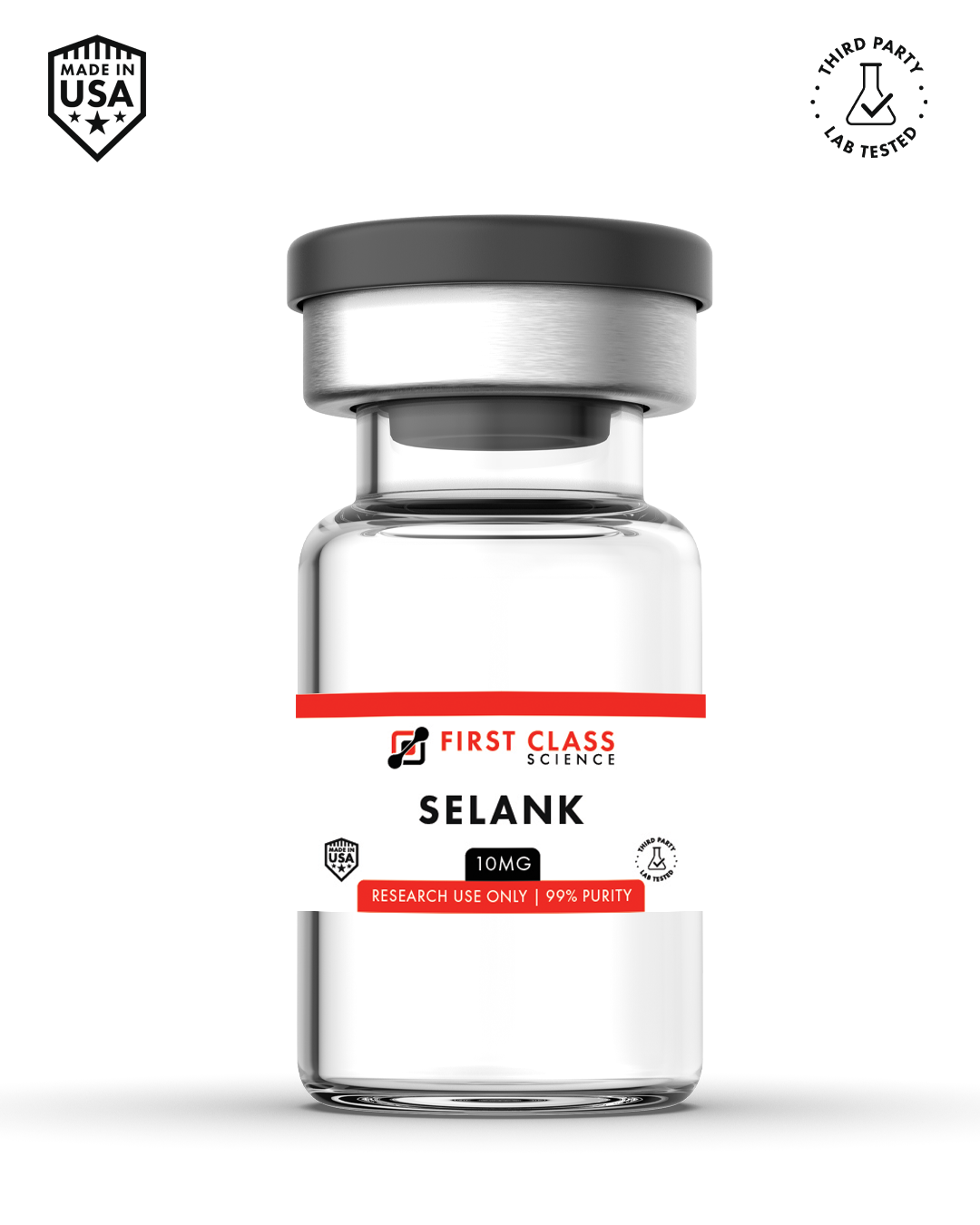
Selank – 10mg
10mg – Lyophilized MUST BE RECONSTITUTED Selank is a synthetic peptide analog of tuftsin studied in preclinical and early clinical research for its potential relevance to anxiety-related behavior, cognitive performance, and immune signaling. Supplied at research-grade purity for laboratory use only.
$175.00
Selank is a synthetic heptapeptide derived from tuftsin, a tetrapeptide fragment of immunoglobulin G first identified for its role in immune signaling. Published research has examined Selank’s anxiolytic-like activity in animal and clinical study models, its relationship to memory and learning performance, its effect on hippocampal BDNF expression, and its antiviral and immune-modulating activity. The summary below reflects the peer-reviewed and preclinical literature and is provided for research reference only — it does not describe intended effects of this product in humans or animals.
Product Details
- What is Selank?
- Selank Structure
- Selank Research
What is Selank?
Selank (Thr-Lys-Pro-Arg-Pro-Gly-Pro) was synthesized by researchers at Russia’s Institute of Molecular Genetics as an extended-duration analog of tuftsin, an immunoglobulin G-derived tetrapeptide the body produces naturally. Appending a Pro-Gly-Pro sequence to tuftsin’s backbone was reported to extend the molecule’s metabolic half-life while preserving the anxiolytic- and cognition-related activity noted in tuftsin research.
Researchers propose that Selank acts on two systems: central nervous system signaling and immune activity. Study authors attribute its calming effects in tested models to allosteric modulation at the GABA-A receptor, a mechanism reported to produce benzodiazepine-like anxiolytic activity in those models without the muscle relaxation, sedation, or withdrawal effects associated with that drug class. Some studies also report improved learning and mental clarity measures relative to benzodiazepine comparators in the models tested.
Gene-expression research indicates Selank altered activity across GABA, dopamine (D1, D2, D5), and serotonin receptor networks in the frontal cortex and hippocampus of tested animal models — in one study, a single dose shifted expression of 45 neurotransmission-related genes within 60 minutes.
Selank has also been studied for its effect on enkephalin-degrading enzymes; researchers report the peptide slows enkephalin breakdown, an effect proposed as a contributor to the anxiolytic activity observed in these studies, with reported potency exceeding reference peptidase inhibitors such as bacitracin and puromycin in vitro.
Separate research examined Selank’s effect on cytokine gene expression, reporting shifts across 34 inflammation-related genes in one study, including targets tied to immune system development (Bcl6) and complement/interleukin pathways. Selank concentrations have also been reported to respond to stress exposure in tested models, described by study authors as an adaptogen-like pattern.
Chemical Identity
Selank’s defined molecular structure and characterized physical properties make it a well-documented candidate for laboratory research.
Systematic IUPAC Name: (2S)-1-[2-[[(2S)-1-[(2S)-2-[[(2S)-1-[(2S)-6-amino-2-[[(2S,3R)-2-amino-3-hydroxybutanoyl]amino]hexanoyl]pyrrolidine-2-carbonyl]amino]-5-(diaminomethylideneamino)pentanoyl]pyrrolidine-2-carbonyl]amino]acetyl]pyrrolidine-2-carboxylic acid
Purity & Quality
First Class Science supplies Selank at research-grade purity for laboratory and experimental use. Every production batch is tested to confirm identity and purity, with a Certificate of Analysis available per batch.
Important: This item is manufactured strictly for research purposes. It is not intended for human or veterinary use and is distributed solely for laboratory and scientific investigation.
Selank Structure
Chemical Structure
2D and 3D structure renderings are available via the compound’s public PubChem record (CID 11765600).
Chemical Properties
| CAS Number | 129954-34-3 |
| Molecular Formula | C33H57N11O9 |
| Molecular Weight | 751.9 g/mol |
| InChIKey | JTDTXGMXNXBGBZ-YVHUGQOKSA-N |
Full compound data: PubChem CID 11765600 (pubchem.ncbi.nlm.nih.gov/compound/11765600)
Selank Research
Research Applications
Anxiety & Stress-Response Models
A clinical trial (Zozulya et al., 2008) compared Selank against medazepam, a benzodiazepine-class comparator, in 62 patients diagnosed with generalized anxiety disorder or neurasthenia. Across three validated rating scales, researchers reported comparable reductions in anxiety measures between arms, with the Selank arm additionally showing antiasthenic and mild psychostimulant measures not reported in the medazepam arm. A subset of participants (~40%) were classified by study authors as “rapid responders.” A second trial (Dorofeeva et al., 2009, n=70) reported fewer benzodiazepine-associated side effects (memory/attention measures, sedation, blood pressure changes) when Selank was combined with phenazepam versus phenazepam alone. Gene-panel research in rat frontal cortex (Volkova et al., 2016) found dose-dependent changes across 45 neurotransmission-related genes, a pattern study authors say is consistent with GABA-A allosteric modulation.
Sources
- Zozulya AA, et al. “Efficacy and possible mechanisms of action of a new peptide anxiolytic selank in the therapy of generalized anxiety disorders and neurasthenia.” Zh Nevrol Psikhiatr Im S S Korsakova. 2008;108(4):38-48.
- European Psychiatry. “Rapid and slow response during treatment of generalized anxiety disorder with peptide anxiolytic Selank.” 2012;27(Suppl 1):1.
- Dorofeeva OA, et al. “Optimization of the treatment of anxiety disorders with selank.” Eksp Klin Farmakol. 2009;72(2):6-10.
- Volkova A, et al. “Selank Administration Affects the Expression of Some Genes Involved in GABAergic Neurotransmission.” Front Pharmacol. 2016;7:31.
- Kasian A, et al. “Peptide Selank Enhances the Effect of Diazepam in Reducing Anxiety in Unpredictable Chronic Mild Stress Conditions in Rats.” Behav Neurol. 2017;2017:5091027.
- Kost NV, et al. “The inhibitory effect of Selank on enkephalin-degrading enzymes as a possible mechanism of its anxiolytic activity.” Zh Vyssh Nerv Deiat Im I P Pavlova. 2001;51(5):605-613.
Cognitive & Memory-Related Research
Rodent studies (Sokolov et al., 2010) reported that a single dose administered during memory consolidation was associated with a stable memory trace for up to 30 days in tested animals, alongside increased hippocampal serotonin turnover. Chronic-ethanol-exposure studies in rats (Nadorova et al., 2019) reported that Selank dosing was associated with protection against memory and attention deficits typically seen during withdrawal, a finding researchers linked to hippocampal/prefrontal BDNF regulation. Additional gene-expression research (Inozemtseva et al., 2008) found intranasal dosing associated with rapid shifts in hippocampal BDNF mRNA and protein levels in tested models.
Sources
- Sokolov OY, et al. “Experimental optimization of learning and memory processes by selank.” Zh Vyssh Nerv Deiat Im I P Pavlova. 2010;60(5):505-512.
- Nadorova AV, et al. “Selank, Peptide Analogue of Tuftsin, Protects Against Ethanol-Induced Memory Impairment by Regulating of BDNF Content in the Hippocampus and Prefrontal Cortex in Rats.” Bull Exp Biol Med. 2019;167(6):843-846.
- Inozemtseva LS, et al. “Intranasal administration of the peptide Selank regulates BDNF expression in the rat hippocampus in vivo.” Dokl Biol Sci. 2008;421:241-243.
- Sokolov OY, et al. “Effects of Selank on behavioral reactions and activities of plasma enkephalin-degrading enzymes in mice with different phenotypes of emotional and stress reactions.” Bull Exp Biol Med. 2002;133(2):133-135.
Neuroprotection-Related Research
Cell-based research (Filatova et al., 2017) using gene-set enrichment analysis on Selank-treated neuroblastoma cells flagged GABA signaling as the most affected pathway, with BDNF central to that network. Rodent studies reported reduced free-radical concentration in liver tissue at tested doses, and a mouse spleen gene panel (Kolomin et al., 2011, 2013) found shifts across 34 inflammation-related genes following dosing.
Sources
- Filatova E, et al. “GABA, Selank, and Olanzapine Affect the Expression of Genes Involved in GABAergic Neurotransmission in IMR-32 Cells.” Front Pharmacol. 2017;8:89.
- Kolomin TA, et al. “The temporary dynamics of inflammation-related genes expression under tuftsin analog Selank action.” Immunobiology. 2013;218(11):1407-1413.
- Kolomin TA, et al. “Expression of inflammation-related genes in mouse spleen under tuftsin analog Selank.” Immunobiology. 2011;216(9):998-1003.
- Kost NV, et al. “Semax and Selank Inhibit the Enkephalin-Degrading Enzymes of Human Serum.” Russian Journal of Bioorganic Chemistry. 2001;27(2):156-159.
Immune & Antiviral Research
As a tuftsin analog, Selank has been studied for immune-signaling properties. Research against influenza A/Aichi 2/68 (H3N2) in cell culture and animal models (Ershov et al., 2009) reported the strongest antiviral effect under preventive dosing, with study authors linking this to selective interferon-alpha induction. Additional research has examined activity against influenza B, H5N1, HSV-1/2, cytomegalovirus, and murine encephalomyocarditis virus in laboratory models.
Sources
- Ershov FI, et al. “Antiviral activity of immunomodulator Selank in experimental influenza infection.” Vopr Virusol. 2009;54(5):19-24.
- Kolomin TA, et al. “Expression of inflammation-related genes in mouse spleen under tuftsin analog Selank.” Immunobiology. 2011;216(9):998-1003.
- Kolomin TA, et al. “The temporary dynamics of inflammation-related genes expression under tuftsin analog Selank action.” Immunobiology. 2013;218(11):1407-1413.
- Andreeva LA, et al. “Antiviral properties of structural fragments of the peptide Selank.” Bioorg Khim. 2010;36(2):272-276.
What the Human Evidence Shows
Researchers evaluating Selank should know that a body of published clinical research exists, conducted in Russia under Russian regulatory and publication standards distinct from Western (FDA/EMA) randomized-controlled-trial design. The Zozulya et al. (2008) and Dorofeeva et al. (2009) trials cited above are the primary published human evidence, examining Selank against benzodiazepine comparators in generalized anxiety disorder and neurasthenia. Independent replication of these findings under FDA/EMA-standard trial design has not been published.
This distinction matters for how findings from this page should be characterized. Selank is not an FDA-approved drug for any indication, has not completed a Western regulatory clinical-trial pathway, and is not evaluated by the FDA for safety or efficacy in humans or animals under this research-use-only sale. A researcher citing the Russian clinical literature in a grant application or protocol design should describe it accurately as reflecting a distinct regulatory and publication context, not as FDA/EMA-standard clinical evidence.
Compared to Related Research Compounds
Selank is frequently studied alongside other ACTH-derived and nootropic-adjacent research peptides. First Class Science supplies a related preparation for researchers running comparative studies:
Semax / Selank – 10mg/10mg pairs Selank with Semax, a separately-studied BDNF-associated heptapeptide, for laboratories modeling combined anxiolytic- and nootropic-pathway research protocols. A standalone Semax – 10mg vial is also available.
Each related preparation carries its own Certificate of Analysis and is subject to the same research-use-only terms described on this page.
Frequently Asked Questions
What is the purity of this Selank research peptide?
Every production batch is independently tested to confirm identity and purity, with a Certificate of Analysis available per batch.
How should Selank research peptide be stored?
Store the lyophilized powder at −20°C for long-term stability. After reconstitution with bacteriostatic or sterile water, refrigerate at 2–8°C and use within 4–6 weeks; avoid repeated freeze-thaw cycles.
Is Selank approved for human or animal use?
No. Selank is not an FDA-approved drug for any indication and has not completed a Western regulatory clinical-trial pathway. It is sold exclusively for in vitro and laboratory research use.
Has Selank been tested in humans at all?
Yes, in Russia, under Russian regulatory and publication standards. Published trials compared Selank against benzodiazepine comparators (medazepam, phenazepam) in patients with generalized anxiety disorder or neurasthenia. Independent replication under Western randomized-controlled-trial standards has not been published.
How does Selank differ from Semax?
Both are Russian-developed heptapeptides extended with a Pro-Gly-Pro tripeptide for stability. Selank is derived from tuftsin and studied primarily for GABA-A-mediated anxiolytic activity; Semax is derived from ACTH(4-10) and studied primarily for BDNF/neurotrophin signaling. Researchers frequently study them individually or combined.
What does the Certificate of Analysis show?
The Certificate of Analysis published for each batch documents HPLC purity results and molecular-identity confirmation, allowing researchers to independently verify the identity and purity of the specific batch they receive.
Can Selank research peptide be shipped internationally?
Shipping availability and any import restrictions for research peptides vary by destination country and are subject to change; researchers should confirm their local import regulations for research-use-only compounds before ordering.
Disclaimer: The research summarized above is drawn from third-party published studies conducted in animal, in vitro, or non-U.S. clinical contexts. It is provided for research and educational reference only and does not describe an intended use, effect, or benefit of this product for any person or animal.
⊗ ALL ITEMS ARE SOLD FOR RESEARCH USE ONLY. This category covers strictly in vitro laboratory testing and scientific experimentation. Content on this site is for education only and does not authorize human or animal use of any kind, which is prohibited by law. Only trained, licensed professionals should handle these materials. Nothing sold here qualifies as a drug, food, or cosmetic, and none of it may be labeled, advertised, or used as such.