

Product Usage: For Research Use Only – Not for Human or Veterinary Use
This product is not a drug, food, cosmetic, or dietary supplement and has not been evaluated by the FDA. It is strictly intended for in vitro research by qualified professionals. Any use in humans or animals is strictly prohibited and may violate federal, state, or local laws, including the Federal Food, Drug, and Cosmetic Act. No therapeutic or diagnostic application is implied or permitted. The purchaser assumes all responsibility for compliance with applicable regulations.
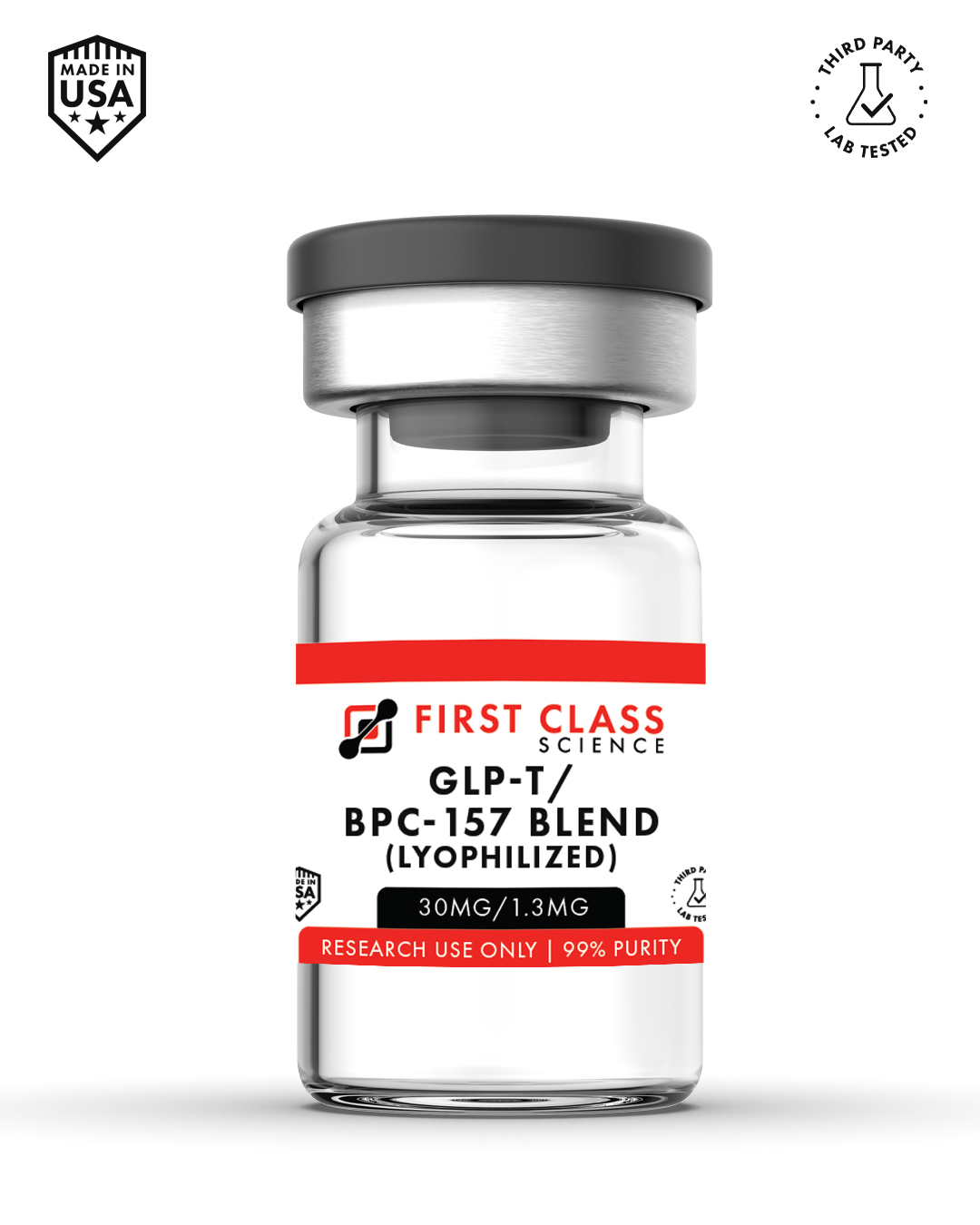
GLP-T / BPC-157 Blend (Lyophilized) 30mg/1.3mg
30mg/1.3mg lyophilized blend combining GLP-T (tirzepatide) and BPC-157, two individually documented research peptides studied for GLP-1/GIP receptor pathway activity and cellular/tissue-signaling research, respectively. Supplied at research-grade purity for laboratory use only.
$400.00
The GLP-T / BPC-157 Blend combines two individually documented research peptides — tirzepatide (site code GLP-T) and BPC-157 — each studied in its own body of published literature. Researchers combine peptides such as these to study multiple signaling pathways in parallel; the summary below describes each component’s own published research individually. No combined-blend study is described or implied.
What is in the GLP-T / BPC-157 Blend?
Tirzepatide (GLP-T)
Tirzepatide is a synthetic 39-amino-acid peptide engineered as a dual agonist at both the GLP-1 and GIP (glucose-dependent insulinotropic polypeptide) receptors. Published clinical research has examined tirzepatide’s association with measures of glycemic control and body-weight change in randomized trials, and preclinical research has examined its dual-receptor binding pharmacology and downstream incretin-signaling effects in cell and animal models.
BPC-157
BPC-157 is a synthetic pentadecapeptide derived from a fragment of body-protection-compound protein originally identified in human gastric juice. Published preclinical research, much of it from a research group based in Croatia, has examined BPC-157’s association with angiogenesis markers, tendon- and ligament-healing measures, and gastrointestinal-mucosa protection in rodent injury models.
Chemical Identity
| Tirzepatide CAS Number | 2023788-19-2 |
| Tirzepatide Molecular Formula | C225H348N48O68 |
| Tirzepatide Molecular Weight | ~4813.5 g/mol |
| BPC-157 CAS Number | 137525-51-0 |
| BPC-157 Molecular Formula | C62H98N16O22 |
| BPC-157 Molecular Weight | ~1419.5 g/mol |
Purity & Quality
First Class Science supplies the GLP-T / BPC-157 Blend at 99% purity, verified by independent third-party HPLC testing and mass spectrometry. A Certificate of Analysis is available for every batch at https://firstclassscience.com/certificate-of-analysis/. Store lyophilised compound at −20°C for long-term stability; refrigerate at 2–8°C after reconstitution and use within 4–6 weeks.
Important: This item is manufactured strictly for research purposes. It is not intended for human or veterinary use and is distributed solely for laboratory and scientific investigation.
Research Applications
Incretin Receptor Pathway Research (Tirzepatide)
Randomized clinical trials have examined tirzepatide’s dual GLP-1/GIP receptor activity and reported measures of glycemic control and body-weight change relative to placebo and comparator arms; preclinical work has separately examined receptor-binding kinetics and downstream cAMP-signaling effects in cell-based assays.
Tissue-Repair & Gastrointestinal Research (BPC-157)
Preclinical studies in rodent models have reported associations between BPC-157 administration and angiogenesis and tendon-fibroblast outgrowth measures, as well as protective effects on gastrointestinal-mucosa integrity in chemically induced injury models. This research remains preclinical and has not been established for human use.
Multi-Pathway Research Rationale
Researchers studying metabolic and tissue-repair pathways in parallel sometimes combine peptides with distinct proposed mechanisms, such as incretin-receptor signaling and tissue-repair-related signaling, to examine multiple biological systems within a single experimental protocol.
Disclaimer: The research summarized above is drawn from third-party published studies conducted in animal, in vitro, or non-U.S. clinical contexts. It is provided for research and educational reference only and does not describe an intended use, effect, or benefit of this product for any person or animal.
⊗ ALL ITEMS ARE SOLD FOR RESEARCH USE ONLY. This category covers strictly in vitro laboratory testing and scientific experimentation. Content on this site is for education only and does not authorize human or animal use of any kind, which is prohibited by law. Only trained, licensed professionals should handle these materials. Nothing sold here qualifies as a drug, food, or cosmetic, and none of it may be labeled, advertised, or used as such.